Hsi Lai Temple Eight Precepts Retreat: Hearing, Reflection, Practice, and Realization in the Human World
Reported by Pan Ching Xia, The Life News Agency, Los Angeles, USA
“Can you practice in accordance with Dharma?” “Yes, we will practice in accordance with the teachings!”
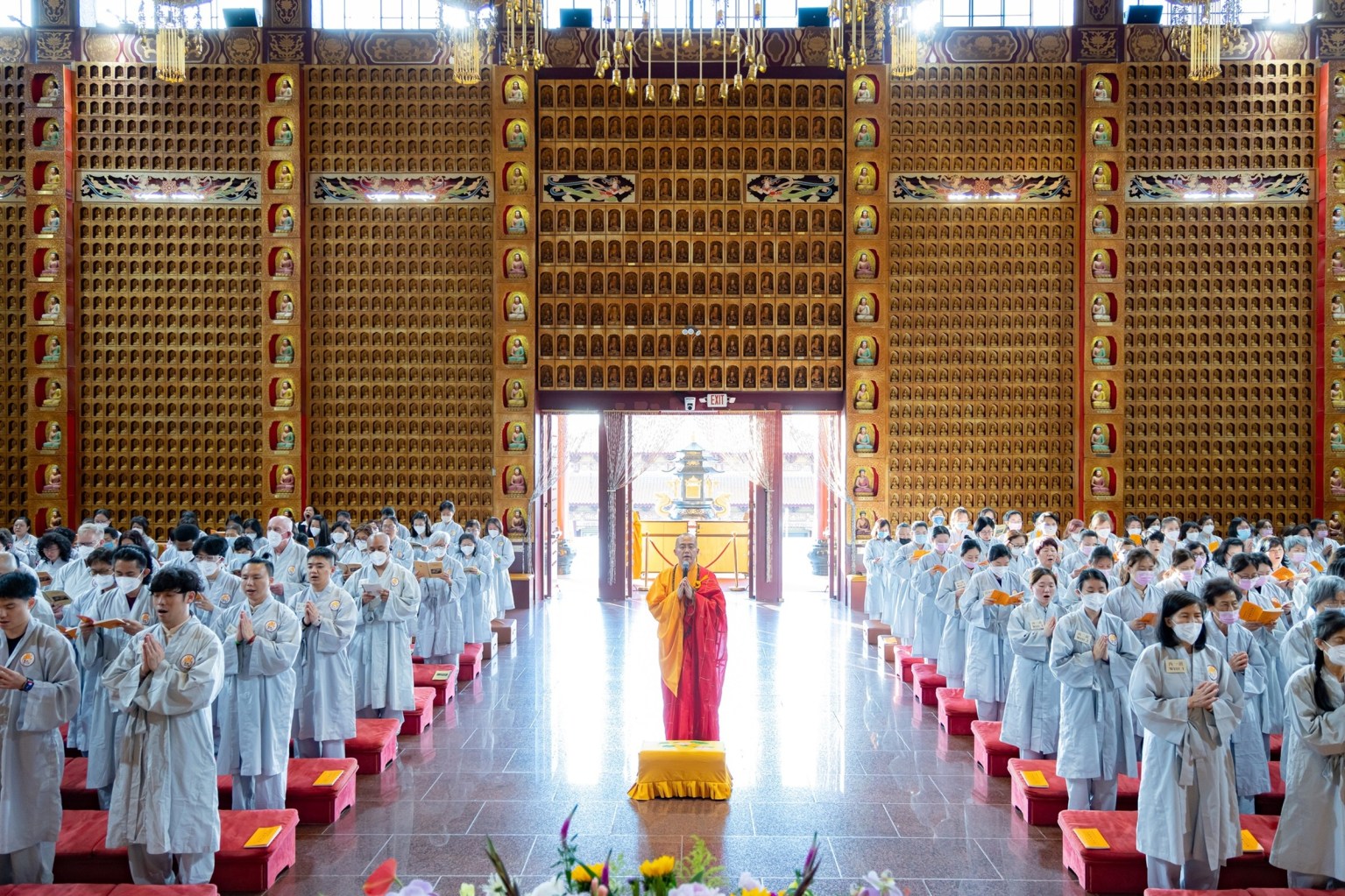
On May 24, Fo Guang Shan Hsi Lai Temple held a bilingual (Chinese–English) Eight Precepts Retreat, with 203 participants making the heartfelt vow to receive the precepts and to observe, for one full day and night, a disciplined and simple monastic lifestyle. By planting wholesome causes for future liberation, the participants deepened their understanding of precepts and the spirit of Humanistic Buddhism through Buddhist studies, learned calm and contemplation in Chan practice, and applied cultivation in daily life—cultivating the principle of “listen, contemplate and practice in the human world.”
The formal conferral of the precepts was presided over by Venerable Huidong, Abbot of Hsi Lai Temple. Leading the participants in accordance with the ritual procedures, he guided them in repentance of past unwholesome actions and explained that the Eight Precepts serve as a foundational preparatory practice for lay Buddhists. The Buddhas and Dharma protectors were then respectfully invited to bear witness and safeguard the precept platform. As the participants received the precept essence and generated bodhicitta, they responded in unison with “Yes, we can uphold them” as each of the Eight Precepts was proclaimed.
During the midday meal, Venerable Huidong further expounded on the meaning of the precept essence, explaining that it arises from inner awareness and serves as a moral force that reminds practitioners to refrain from wrongdoing and cease unwholesome actions. Participation in the retreat, he noted, is precisely a means of learning how to activate this precept essence in daily life, thereby purifying the three karmas of body, speech, and mind.
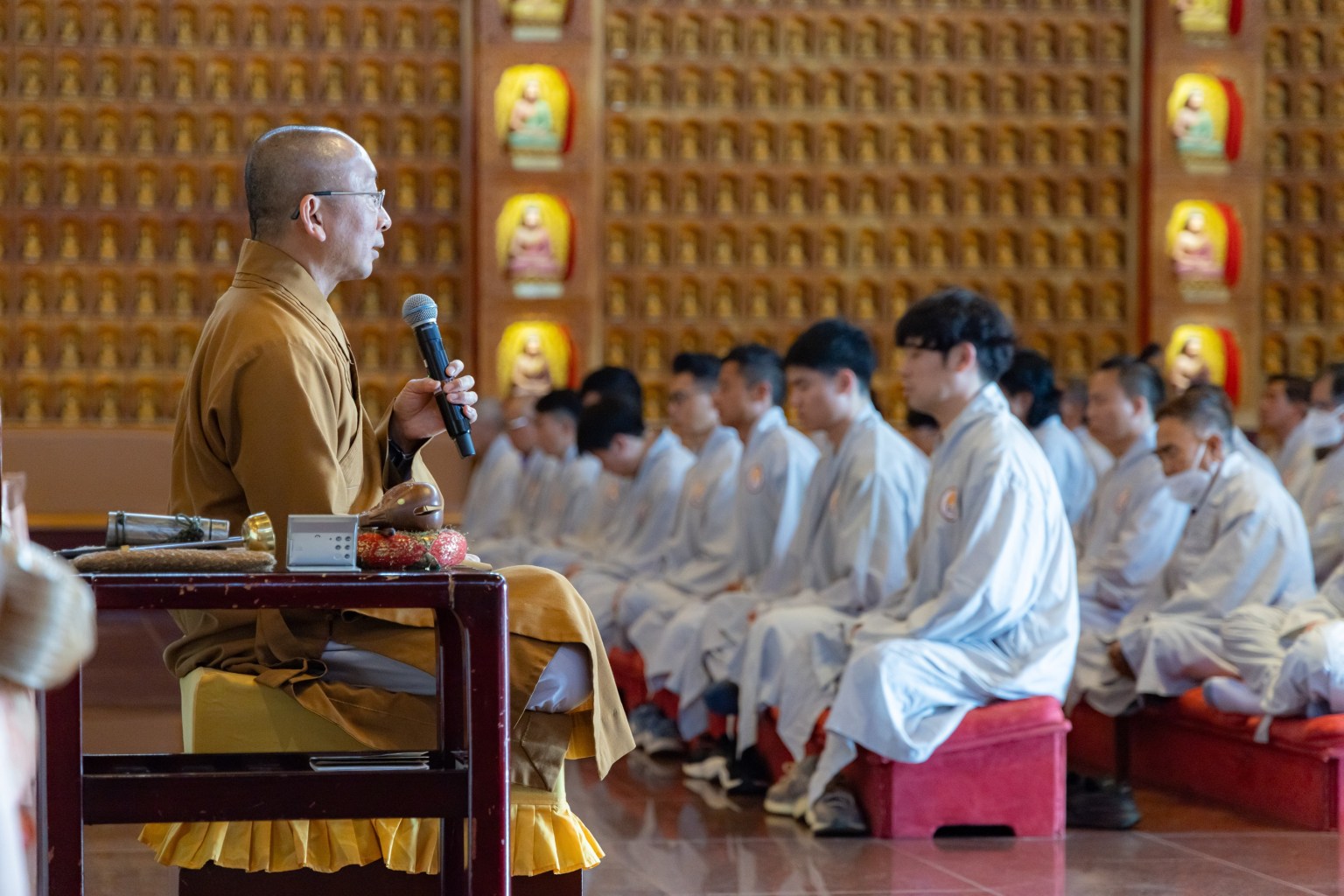
In the course “Observing the Precepts and Cultivation,” Venerable Huidong emphasized that the core spirit of the Eight Precepts encompasses not only restraining conduct—refraining from all evil—but also active cultivation—engaging positively in wholesome deeds. The first five precepts focus on non-harm, while the latter three emphasize non-indulgence and mindfulness. He stressed that observing the precepts is the foundation of Buddhist practice, and that true liberation must be built upon the Threefold Training of precepts, concentration, and wisdom. Quoting Precepts, Concentration, and Wisdom in Humanistic Buddhism by Venerable Master Hsing Yun, he highlighted the importance of generating bodhicitta for both self-benefit and the benefit of others. The session also addressed participants’ questions regarding precept observance. The English-language course was taught by Venerable Miaoxi.
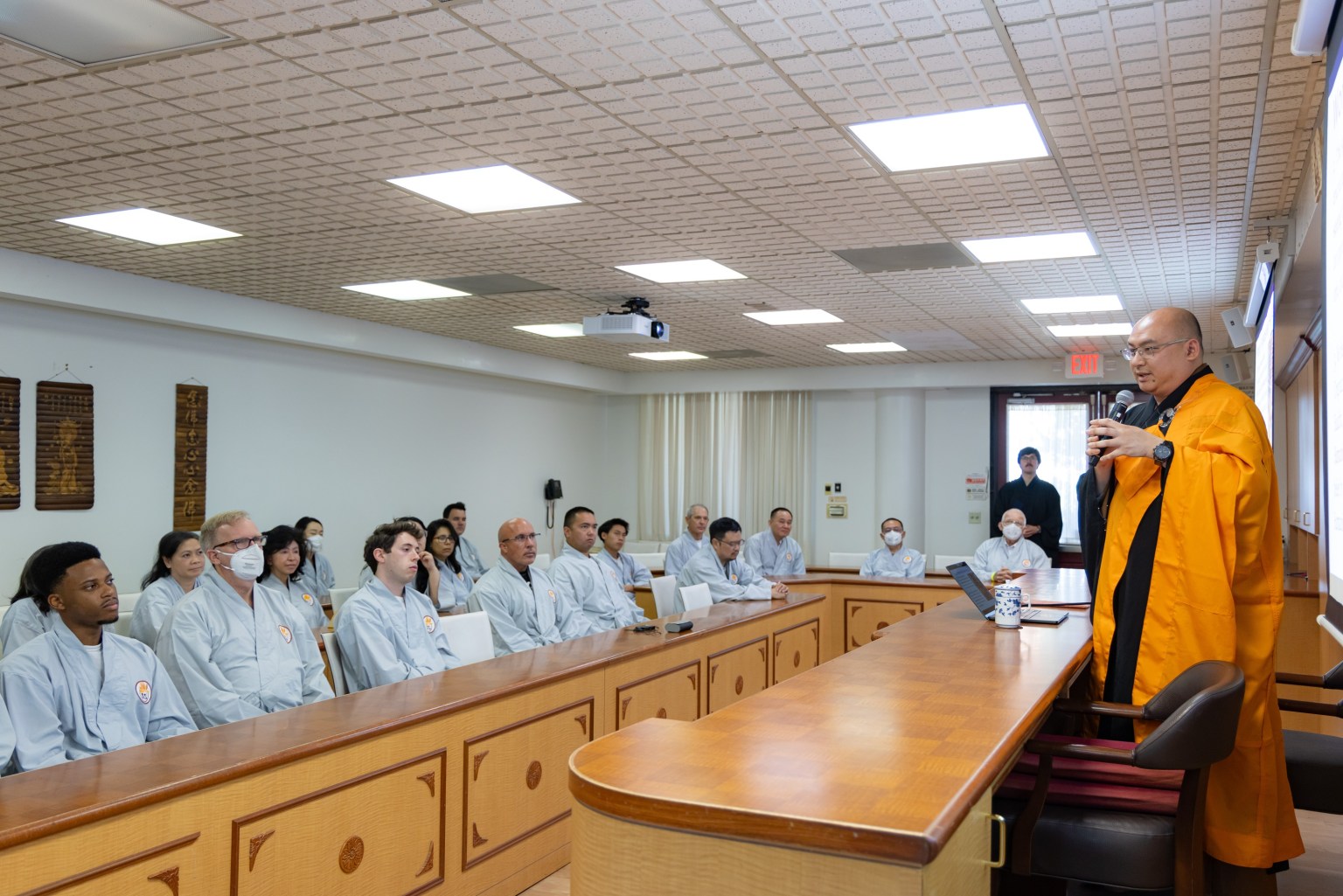
The English course “Quotes from Venerable Master Hsing Yun,” taught by Venerable Huize, drew from Humanistic Buddhism: The Buddha’s Original Intent. The class elaborated on the Master’s teaching of “I am a Buddha,” affirming that all sentient beings inherently possess Buddha-nature. Quoting the Āgama Sutras—“Rely on yourself; rely on the Dharma; rely on nothing else”—Venerable Huize explained that the true refuge lies in one’s own intrinsic Buddha-nature. He further noted the Master’s emphasis on “being among the people and sharing one body with all,” reflecting the co-existence spirit of Humanistic Buddhism. The Chinese-language counterpart was taught by Venerable Juemiao, who cited A Poor Monk Has Something to Say, Vol. 8: The Importance of Human Causes and Conditions, emphasizing the cultivation, cherishing, and creation of positive affinities in daily life.
The Chan meditation course, guided by Venerable Huixuan, emphasized practicing calm and contemplation amid daily encounters and circumstances. Key elements included regulating the body, breath, and mind through clear awareness of the changing Five Aggregates, maintaining a mind that is focused yet relaxed, calm and not scattered, and living fully in the present with a mind free from grasping, discrimination, and calculation. Through contemplation of the interconnection between precepts, Dharma and cultivation in everyday life, participants can realize that listening, contemplation and practice, are inseparable from the human world. The English meditation session was guided by Venerable Huicheng.
Additionally, during the combined Chan and Pure Land practice, Venerable Huidong and the monastics led the participants in collective chanting of the Buddha’s name. As the resonant tones filled the hall, participants circumambulated mindfully, gathering body and mind through each recitation. After settling into stillness, Venerable Huidong reminded everyone that sustained observance of the precepts and cultivation would naturally lead to freedom from afflictions.
Participant Brian Chansy, attending the Eight Precepts Retreat for the first time, shared that the course on Venerable Master Hsing Yun’s quotes greatly benefited him and deepened his understanding of Humanistic Buddhism. Erika Flores, also a first-time participant, reflected on gaining a deeper appreciation for “living in the present moment.” Both expressed gratitude for the rare and meaningful opportunity to learn and practice alongside fellow participants.
Liang Huixian, President of the San Gabriel First Chapter of the BLIA Los Angeles Chapter, shared her joy in attending the retreat with ten fellow members, describing the experience as a rare and auspicious condition. She expressed gratitude for the inspiration gained from the “Quotes of Venerable Master Hsing Yun” course. Participant Zhang Hao remarked that Venerable Huidong’s clear and accessible teachings helped him truly understand the meaning of observing the precepts. He also shared that the Master’s quotes enabled him to appreciate the profound dedication behind the establishment of Fo Guang Shan, while the meditation course guided him in cultivating self-awareness.
Photo Captions (Photos 01–09 by Chang Chih Cheng; Photo 10 by Zhiqian)
Group photo of all participants.
After registration and receiving name tags, Venerable Rusong, Head Superintendent of Hsi Lai Temple, guides female precept participants into the Main Shrine.
Prior to the formal conferral of the precepts, incense is offered on behalf of all male and female participants by Gary Tang, Head of Youth Group II, and Echo Tsai, President of the BLIA Los Angeles Chapter.
The formal conferral of the Eight Precepts is presided over by Venerable Huidong, Abbot of Hsi Lai Temple.
Venerable Huicheng, the ceremonial guide, instructs first-time local participants on monastic dining etiquette.
In the Chinese-language course “Observing the Precepts and Cultivation,” Venerable Huidong explains the core spirit of the Eight Precepts.
The English-language course “Sayings of Venerable Master Hsing Yun” is taught by Venerable Huize.
Venerable Huixuan leads the Chinese-language Chan meditation session.
Venerable Huidong and the monastics lead participants in combined Chan and Pure Land practice through collective Buddha-name chanting, gathering body and mind in mindful concentration.
Liang Huixian (right), President of the San Gabriel First Subchapter of the BLIA Los Angeles Chapter, and Zhang Hao (left) from the Riverside Subchapter are interviewed.